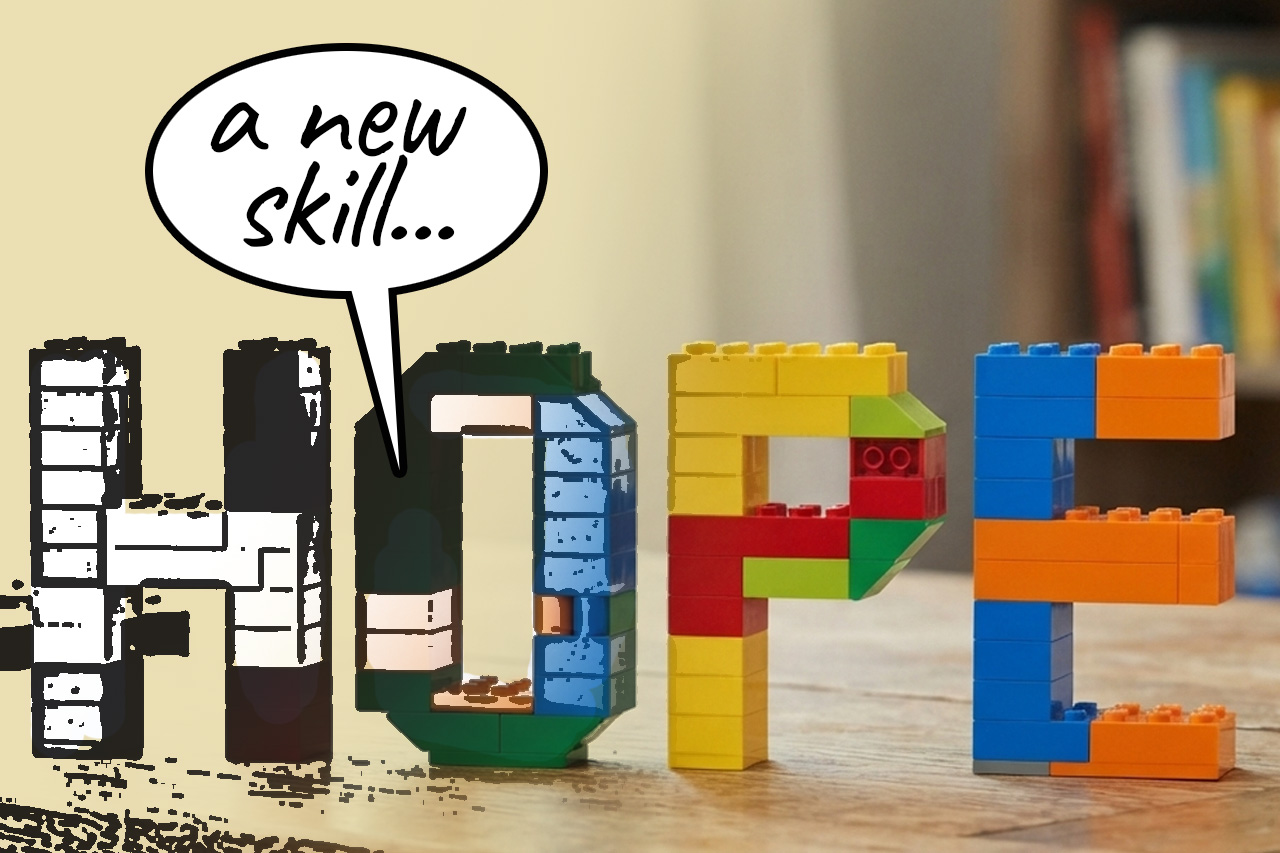
How resilience, confidence, and the right support system help students own their future: one pathway at a time.
Life is not a straight line. If you’ve ever felt like your path looks more like a zig-zag than a highway, sprinkled with a few detours, a couple of do-overs, and maybe a wrong turn, two possibly three, you’re not the only one. You’re experiencing the time where growth actually happens. Every graduate, every entrepreneur, every person you admire has a story full of pivots, restarts, and “I didn’t see that coming” moments. The difference between people who freeze in these moments and people who continue to push through them isn’t luck or talent. Researchers have identified something simpler and far more learnable: HOPE.
What Is Hope, Really? It’s Not a Feeling or an Emotion. It’s a Skill You Can Build
We tend to think of hope as a warm, fuzzy feeling or emotion, something that you experience or you don’t. Psychologist C.R. Snyder’s influential hope theory defines it in the opposite way: hope is a measurable, trainable mindset built from three ingredients working together: a clear goal, pathways thinking (believing you can map out routes to get there, and finding new ones when the first route is blocked), and agency thinking (the motivational energy to actually start moving and keep going) (Yukai Chou).
We believe this new discovery changes everything. It means hope isn’t about pretending things will magically work out. It’s grounding yourself to know what you’re working towards, having different solutions to get there, and being confident to take the next step regardless of the survivability or risk. Now that’s a highly honed skill set and like any skill, it gets stronger with practice and support. That’s worth repeating, PRACTICE AND SUPPORT.
Why Hope Predicts Student Success
The research for students says it all. A meta-analysis of 45 studies involving more than 9,000 students found a consistent, moderate-to-strong positive relationship between hope and academic achievement. Not only that, but the connection was actually stronger for elementary and secondary students than for college students (ERIC). Longitudinal studies have also found that students’ hope scores at the start of a school year meaningfully predict their grades and even their odds of staying enrolled months and years later (PMC). In one striking six-year study of entering college freshmen, high-hope students graduated at meaningfully higher rates than their peers. Intelligence? Luck? Heredity? No, because they kept finding new solutions when old ones closed (Coach Training EDU). Hope, in other words, isn’t a nice bonus. It’s one of the most powerful predictors we have of whether someone reaches their goals.
Ups and Downs Are Part of the Journey of Life, Not a Detour From It
Here’s the part worth repeating on your hardest and most challenging days: resilience was never about avoiding hard things. The American Psychological Association defines resilience as the process of successfully adapting to difficult experiences — through flexibility, adjustment, and the coping strategies people build and practice over time (APA). Notice the word “process.” Resilience isn’t a personality trait or some intrinsic characteristic that people are either born with or without. It’s practiced and purposefully built, one hard moment at a time, the same way hope is built. You build and continue to fortify your skillset related to hope through goals, pathways, and the belief that you have agency over what happens next.
So if this semester, this job, or this chapter of your life hasn’t gone the way you pictured, you don’t throw in the towel or stick your head in the sand. The raw material of resilience is culminated through those difficulties you face head on. Every time you actively choose a new pathway after an old one closes, you’re not just solving today’s problem, you’re strengthening the exact mental muscle that will carry you through the things you haven’t even thought about in the future like your first apartment, your first “real” job, the next relationship, the next reinvention. Confidence isn’t built on success. It develops from the growing experiences, collected one recovered stumble at a time, and each opportunity you take to get back up.
How Adults Can Support Student Resilience: Be the Pathway, Not A Bystander
The thing about Hope is that it isn’t curated in isolation. Adults in a student’s life matter enormously. Decades of research on resilience consistently point to one factor above almost all others: so a close, supportive relationship with at least one caring adult, whether a parent, teacher, or mentor (APA Monitor). Researchers Fergus and Zimmerman describe these adults as “resources” and external supports that work hand in hand with a student’s own internal assets, like self-efficacy and future orientation, to interrupt the slide from setback to giving up (PMC).
Sources
- Yukai Chou, “Hope Theory: Snyder’s Pathways and Agency”
- ERIC, “Hope and Academic Achievement: A Meta-Analysis”
- PMC, “Hope and Student Persistence”
- Coach Training EDU, “Hope and Academic Performance”
- American Psychological Association, “Resilience”
- APA Monitor, “The Road to Resilience”
- PMC, “Fergus and Zimmerman on Resilience Resources”
- Evidence-Based Mentoring, “Long-Term Impacts of Natural Mentors”
- William & Mary ScholarWorks, “Mentoring and the Transition to Adulthood”